Quick Answer
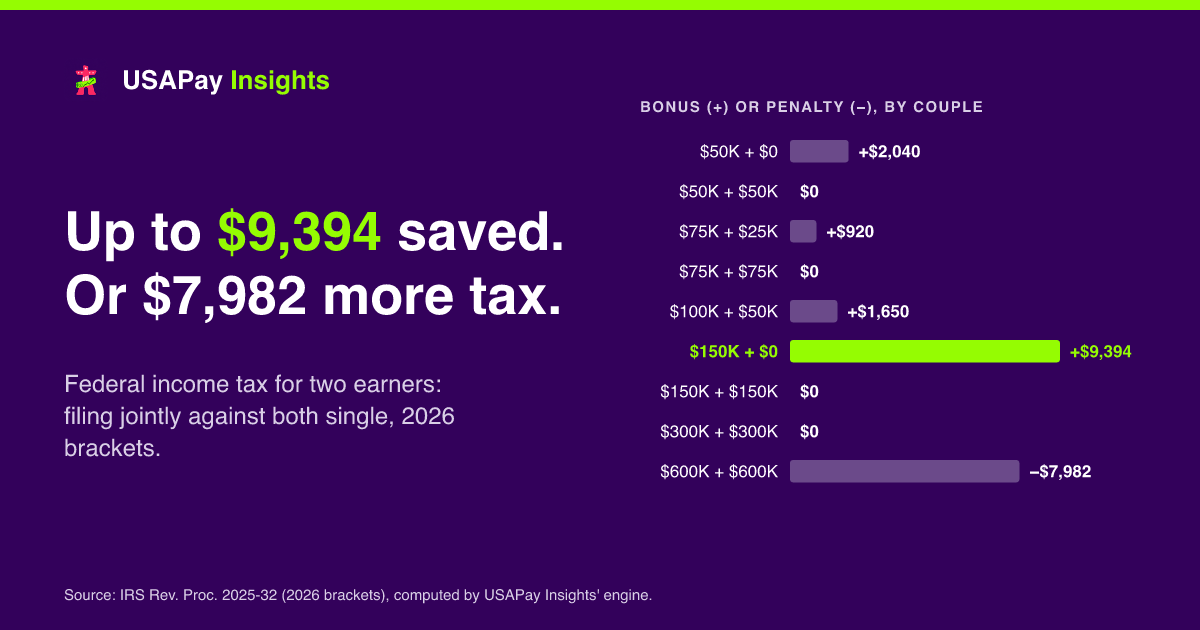
Usually it cuts it or leaves it unchanged. Under 2026 federal brackets a couple with one main earner saves up to $9,394, evenly matched couples see no change, and a penalty appears only once combined taxable income passes $768,700, where two $600,000 earners pay $7,982 more.
Filing jointly gives a couple double the single standard deduction ($32,200 against $16,100) and tax brackets exactly twice as wide, all the way up through the 32% band. The 37% bracket is where that stops: it starts at $640,600 of taxable income for a single filer, but at $768,700 for a couple, not $1,281,200.
A plus sign in the table means marriage lowers the couple's federal income tax; a minus sign means it raises it. Social Security and Medicare do not depend on filing status, so they are left out.
Marriage bonus or penalty, 2026 federal income tax
| Earner A | Earner B | Tax if both single | Tax if joint | Difference |
|---|---|---|---|---|
| $50,000 | $0 | $3,820 | $1,780 | +$2,040 |
| $50,000 | $50,000 | $7,640 | $7,640 | $0 |
| $75,000 | $25,000 | $8,560 | $7,640 | +$920 |
| $75,000 | $75,000 | $15,340 | $15,340 | $0 |
| $100,000 | $50,000 | $16,990 | $15,340 | +$1,650 |
| $150,000 | $0 | $24,734 | $15,340 | +$9,394 |
| $150,000 | $150,000 | $49,468 | $49,468 | $0 |
| $300,000 | $300,000 | $136,269 | $136,269 | $0 |
| $600,000 | $600,000 | $346,269 | $354,251 | −$7,982 |
The pattern
The bonus is largest when one partner earns much more than the other, because joint filing spreads the higher income across brackets twice as wide. In the table, a $150,000 earner married to a partner with no wages saves $9,394.
When both partners earn the same, the doubled brackets and deduction leave the bill exactly where it was: every evenly matched couple in the table below the top bracket gets neither a bonus nor a penalty.
Calculate your own take-home pay
Any salary or hourly wage, all 50 states and DC, with city taxes and payroll deductions.
Use the free calculatorFrequently Asked Questions
Is there a marriage penalty in 2026?
Who gets the biggest marriage bonus?
What is the 2026 standard deduction for a married couple?
Useful calculators for this guide
Disclaimer: Figures are estimates of annual tax liability from published federal and state rules, not paycheck withholding, and not tax advice. Your own situation may differ.