Quick Answer
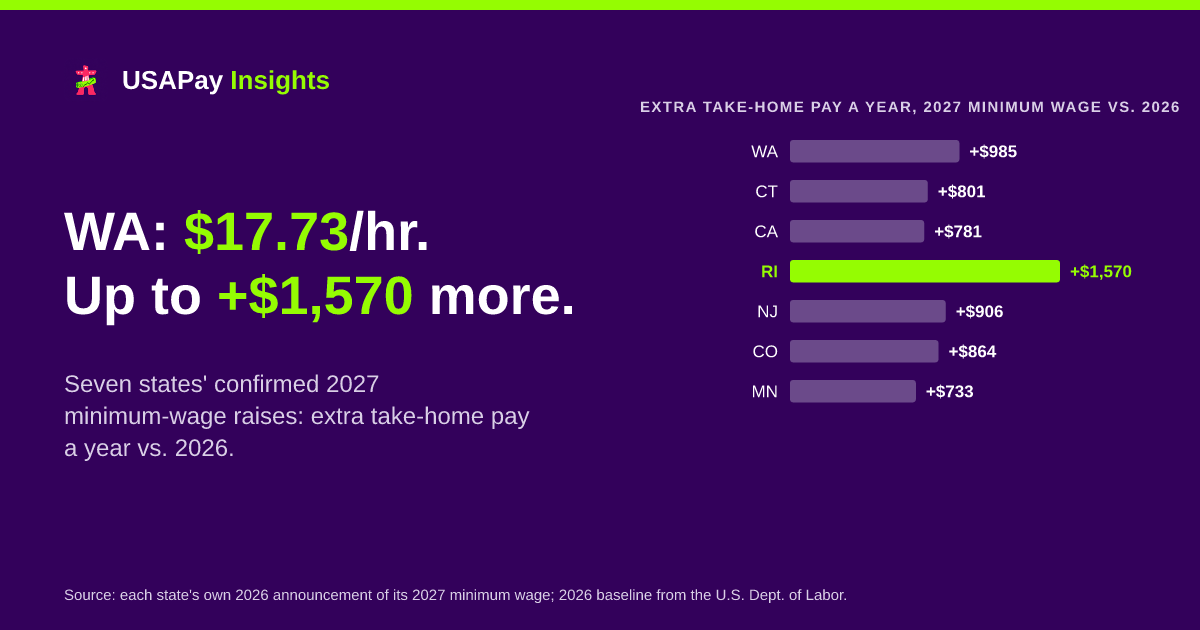
Washington's minimum wage rises to $17.73 an hour on January 1, the highest of seven states confirmed so far for 2027: Washington, Connecticut, California, Rhode Island, New Jersey, Colorado and Minnesota. At full-time hours that is +$985 more take-home pay a year than 2026's rate. New York's rate does not change for 2027.
In late September, Washington confirmed its statewide minimum wage will rise to $17.73 an hour on January 1 — the nation's highest, and the last of seven states to confirm a January 2027 increase. For a full-time, year-round job at the new rate, here is what each state's raise is actually worth after tax, against the 2026 rate it replaces.
Seven states, 2026 rate to 2027
| State | 2026 rate | 2027 rate | Extra take-home/year | Share of the raise kept |
|---|---|---|---|---|
| Washington | $17.13/hr | $17.73/hr | +$985 | 79% |
| Connecticut | $16.94/hr | $17.48/hr | +$801 | 71% |
| California | $16.90/hr | $17.40/hr | +$781 | 75% |
| Rhode Island | $16.00/hr | $17.00/hr | +$1,570 | 75% |
| New Jersey | $15.92/hr | $16.48/hr | +$906 | 78% |
| Colorado | $15.16/hr | $15.71/hr | +$864 | 76% |
| Minnesota | $11.41/hr | $11.87/hr | +$733 | 77% |
Single filer, full-time hours, no pre-tax deductions, both years taxed under 2026 federal and state rules — states have not yet published their 2027 tables, so this isolates what the wage increase itself is worth and leaves out any separate 2027 inflation adjustment to brackets or deductions.
Why the same hourly raise is worth a different amount take-home
Rhode Island's $1.00-an-hour raise is worth the most in take-home dollars, +$1,570 a year, of the seven. Minnesota's raise is worth the least, +$733, because its hourly increase is the smallest of the group. Measured instead by what share of the raise actually reaches the paycheck, Washington keeps the most, 79%, while Connecticut keeps the least, 71% — the rest is federal income tax, Social Security, Medicare and, in most of these states, state income tax on the extra wages.
The state where nothing changes on January 1
New York raised its minimum wage every January for several years running, but not this time: a statutory "off-ramp" condition in state law was triggered, so the rate does not move for 2027. A full-time worker outside the New York City area keeps the same $27,545 a year as in 2026; in New York City, Long Island and Westchester, where the rate is higher, it is $29,095 — the same take-home both years, not a typo. Governor Hochul has proposed changing the off-ramp rule so an inflation increase could still arrive partway through 2027, pending the legislature.
The floor that never moves at all
Every state above is required to pay at least the federal minimum wage, which has not changed since July 2009: $7.25 an hour. A full-time, year-round worker paid exactly that federal floor in a state with no income tax takes home $13,926 a year — less than a full-time worker at Minnesota's 2027 minimum wage of $11.87, the lowest of the seven states raising their floor for 2027.
What this does not tell you yet
Full-time, year-round hours at the stated hourly rate, single filer, no pre-tax deductions, wages only. It does not model tipped minimum wages, training wages for new or young workers, or city and county minimums that sit above the state floor in several of these states. Both years use 2026 tax rules because states have not published their 2027 brackets and deductions yet; the calculator will move to 2027 once they do.
Sources: each state's own 2026 announcement of its 2027 minimum wage, linked by name in the table above; the 2026 baseline and the federal floor from the U.S. Department of Labor, Wage and Hour Division; New York from the Governor's office.
Calculate your own take-home pay
Any salary or hourly wage, all 50 states and DC, with city taxes and payroll deductions.
Use the free calculatorFrequently Asked Questions
Which states are raising their minimum wage in 2027?
Is New York raising its minimum wage for 2027?
How much more take-home pay does a minimum-wage raise actually add?
Useful calculators for this guide
Disclaimer: Figures are estimates of annual tax liability from published federal and state rules, not paycheck withholding, and not tax advice. Your own situation may differ.